
The U.S. sweepstakes gaming market in 2026 is no longer a small side category of online entertainment. It has become a serious business segment sitting between social casino gaming, online gambling, promotional sweepstakes, and state-regulated iGaming.
Its growth has been driven by three realities. First, many U.S. states still do not allow full real-money online casinos. Second, players clearly want mobile-first casino-style entertainment. Third, sweepstakes operators have used a dual-currency model to offer casino-style games while presenting the product as promotional or social gaming rather than direct gambling.
But 2026 is also the year when the market is becoming harder to operate in. Several states have moved from observation to enforcement. Some have passed laws, some have sent cease-and-desist letters, and others are studying whether sweepstakes casinos should be banned, taxed, or regulated like iGaming.
This is the real story of the U.S. sweepstakes market in 2026: high demand, strong monetization, major regulatory pressure, and a business model that is being forced to mature.
What This Report Covers
This article focuses only on the United States sweepstakes gaming market, especially online sweepstakes casino-style platforms that use virtual currencies such as Gold Coins and Sweeps Coins.
It does not cover ordinary brand giveaways, lottery sweepstakes, retail promotional contests, or non-gaming sweepstakes campaigns.
The focus is on:
- Sweepstakes casino business models
- U.S. market growth drivers
- Revenue opportunities
- Stakeholders who benefit
- Regulatory pressure
- Case studies
- Player and consumer risks
- Infographic-ready data points
- 2026 market outlook
Why the Sweepstakes Market Matters in 2026
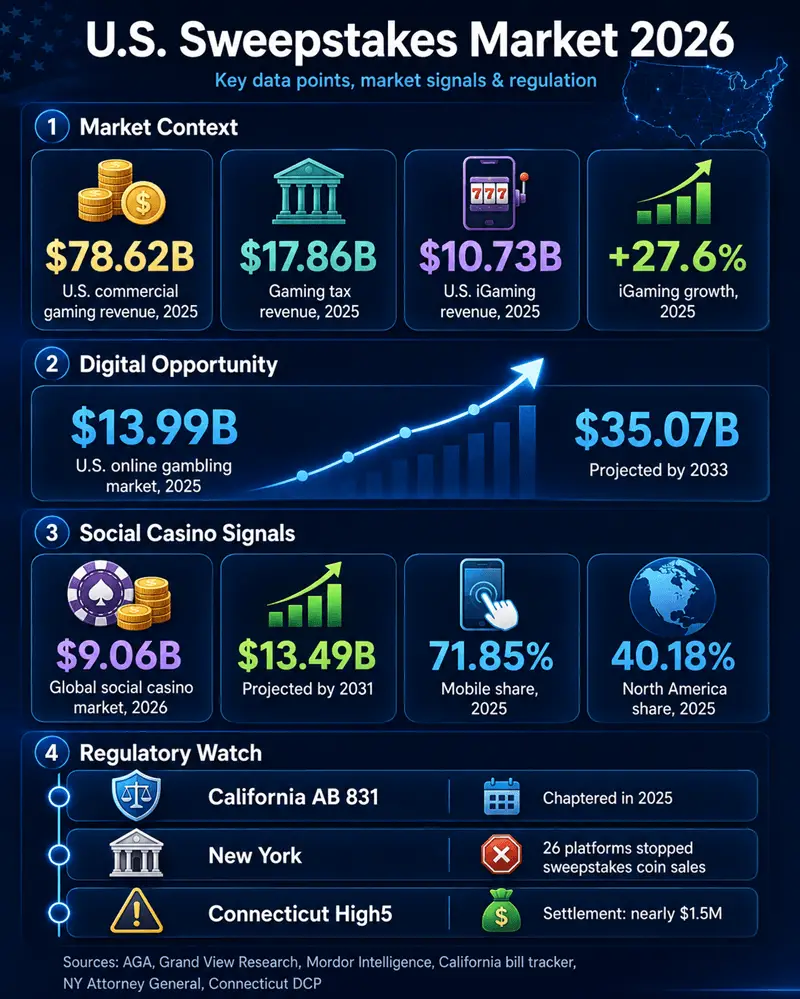
The sweepstakes gaming market matters because it is filling a gap in the U.S. gaming economy. Regulated online casino gaming is still limited. In 2025, lawful internet gaming revenue in the U.S. came from only seven states, even though online casino demand is much broader nationally. The regulated U.S. iGaming market still generated more than $10.73 billion in 2025, growing 27.6% year over year, which shows strong consumer appetite for online casino-style products where legal.
At the same time, the wider U.S. online gambling market is projected to keep expanding. Grand View Research’s Horizon data estimates the U.S. online gambling market generated around $13.99 billion in 2025 and projects it could reach $35.07 billion by 2033, with a 12.2% CAGR from 2026 to 2033. The social casino market is also significant. Mordor Intelligence estimates the global social casino market at $9.06 billion in 2026, growing to $13.49 billion by 2031, with North America as the largest region and mobile apps accounting for more than 71% of 2025 revenue.
Sweepstakes casinos sit near the intersection of these two trends: social casino engagement and real-prize redemption mechanics. That is why the category has become strategically important.
The Core Business Purpose of Sweepstakes Gaming
The business purpose of sweepstakes gaming is simple: create a casino-style entertainment product that can operate in more U.S. markets than traditional licensed online casinos. Traditional iGaming operators need state licenses. They can operate only where online casino gambling is legally authorized. Sweepstakes operators, by contrast, generally rely on promotional sweepstakes structures and dual-currency systems.
The usual business model looks like this:
Players can use Gold Coins for entertainment play. These coins usually have no cash value. Players may receive them for free or buy packages. Players may also receive Sweeps Coins or similar promotional coins. These may be used in eligible games where winnings can potentially be redeemed for cash prizes, gift cards, or other rewards, depending on the platform’s rules. From a business perspective, the operator’s revenue usually comes from selling virtual coin packages, not from directly accepting real-money wagers in the same way a licensed online casino does.
This model gives operators three major business advantages:
Broader market access: Operators can potentially reach players in states where licensed online casinos are not available.
Lower licensing friction: The model may avoid the full licensing burden of regulated iGaming, although this is exactly what regulators are now challenging.
High retention mechanics: Daily bonuses, streaks, promotions, tournaments, VIP systems, coin bundles, and mobile-first play can create strong repeat engagement.
But the same advantages create the central controversy: regulators and licensed gaming stakeholders argue that some sweepstakes platforms look and function too much like online casinos without the same oversight.
Market Position: Not Fully Gambling, Not Fully Social Gaming
The sweepstakes market in 2026 is best understood as a hybrid. A pure social casino does not allow users to redeem winnings for real-world value. Mordor Intelligence defines social casinos as entertainment-oriented platforms using virtual currency, where players do not wager or win real money.
A regulated online casino allows players to deposit real money, wager real money, and withdraw winnings under a state gaming license. A sweepstakes casino sits between these categories. It may look like a social casino at first, but the presence of redeemable promotional coins makes it materially different.
That is why the market is difficult to classify. For players, the experience can feel like online casino gaming. For operators, the legal positioning is promotional sweepstakes/social gaming. For regulators, the question is whether the structure is a legitimate promotional model or unlicensed gambling.
Why the U.S. Market Grew So Fast
1. Limited iGaming legalization
The U.S. has widespread sports betting, but online casino legalization has moved much more slowly. This creates unmet demand in states where consumers want online casino-style entertainment but cannot access regulated iCasino platforms.
In 2025, regulated iGaming was still concentrated in a small number of states, while sports betting and land-based casino gaming had much wider legal footprints.
2. Mobile-first behavior
The modern sweepstakes player is mobile-first. The wider social casino market shows this clearly: mobile apps accounted for 71.85% of global social casino revenue in 2025, according to Mordor Intelligence.
Sweepstakes casinos benefit from the same behavior. Players can log in daily, collect bonuses, complete short sessions, and return through push-style promotional habits.
3. Freemium psychology
The model feels accessible because users can often start without paying. Free coins, daily rewards, and no-purchase entry language reduce the psychological barrier. But monetization comes later through coin bundles, bonus packages, VIP incentives, and redemption-driven engagement.
4. Legal uncertainty creates market opportunity
Where law is unclear, businesses often move faster than regulators. The sweepstakes market grew because many operators believed the model could fit within promotional sweepstakes rules. But that legal uncertainty is now becoming the market’s biggest risk.
Who Benefits From the Sweepstakes Market?
1. Operators
Operators benefit the most when the model works. They can build national-facing brands, sell virtual coin packages, collect recurring revenue from engaged players, and operate across more states than licensed iGaming operators.
The strongest operators also benefit from first-party user data, loyalty programs, retention mechanics, and player segmentation.
2. Game suppliers
Game studios and content suppliers benefit because sweepstakes platforms need slots, table-style games, live-style experiences, crash-style games, bingo, poker-style content, and promotional game formats.
As the category grows, demand increases for games that can work inside both social and sweepstakes structures.
3. Affiliate and media businesses
Affiliate sites, review platforms, SEO publishers, influencers, and paid media networks benefit from player acquisition demand.
This is why the category has become highly competitive in search results. Operators need traffic. Publishers can provide education, comparison content, and market coverage.
However, this is also an area of risk. California’s AB 831 specifically targets not just operators, but also entities such as payment processors, geolocation providers, gaming content suppliers, platform providers, and media affiliates that knowingly support online sweepstakes games within the state.
4. Payment, KYC, fraud, and compliance vendors
As regulation increases, operators need stronger identity verification, fraud detection, age checks, payment screening, chargeback controls, and responsible gaming tools.
This creates a secondary market for compliance infrastructure.
5. Players
Players benefit from access, entertainment, free-play opportunities, and prize redemption possibilities. In states where real-money online casinos are unavailable, sweepstakes platforms may be one of the few ways players can access casino-style digital entertainment.
But players also carry the risk: unclear rules, redemption friction, overspending, weak responsible gaming controls, legal uncertainty, and possible tax obligations.
6. State governments — if regulation replaces grey-market activity
States benefit only if they can regulate, tax, or control the market. In the regulated commercial gaming market, state and local governments received $17.86 billion in direct gaming tax revenue in 2025. This explains why states are sensitive to unlicensed models that may generate gaming-like revenue without equivalent gaming taxes.
The Main Revenue Engine: Virtual Coin Monetization
The sweepstakes business is built on virtual currency.
The operator does not usually say, “Deposit $50 and gamble.” Instead, the platform sells entertainment coin packages, often Gold Coins. Sweeps Coins may be included as a bonus or made available through free methods.
The business goal is to create a loop:
- User signs up
- User receives free coins
- User plays casino-style games
- User sees potential redemption value
- User returns for daily bonuses
- User buys coin packages
- User becomes a repeat customer
- User may enter VIP or loyalty systems
This is why daily rewards, bonus calendars, promotional drops, streaks, tournaments, leaderboards, and limited-time offers are so important. The business is less about one purchase and more about lifetime value.
How the Industry Is Shaping in 2026
The U.S. sweepstakes market is moving in four directions.
1. From open growth to selective state withdrawal
The early growth phase was aggressive. Operators expanded broadly and relied on the argument that their model was not gambling because no purchase was necessary.
By 2026, that strategy is becoming harder.
New York’s Attorney General announced in June 2025 that 26 online platforms offering casino games or sports betting using virtual sweepstakes coins exchangeable for cash and prizes would end the sale of sweepstakes coins in New York after cease-and-desist letters.
California’s AB 831 was chaptered in October 2025 and makes it unlawful to operate, conduct, or offer an online sweepstakes game in the state, while also targeting parties that knowingly support such operations.
This shows a clear shift: large states are not just warning operators; they are changing the operating map.
2. From marketing-led growth to compliance-led survival
In the early phase, the winners were often strong marketers. In 2026, the winners will likely be operators with stronger legal, compliance, and responsible gaming systems.
Age verification, identity checks, redemption reviews, state eligibility rules, self-exclusion tools, AML-style controls, complaint handling, and transparent terms are becoming business necessities.
The National Council on Problem Gambling’s Internet Responsible Gambling Standards include recommendations around policy, staff training, informed player decisions, player assistance, self-exclusion, advertising, game/site features, research, and payments.
Operators that ignore these areas may face higher regulatory, reputational, and litigation risk.
3. From “grey area” to legal classification battles
The major question in 2026 is not whether people enjoy sweepstakes casinos. Clearly, many do.
The question is classification.
Are these platforms promotional sweepstakes? Social casinos? Unlicensed online casinos? A new category needing its own rules?
Different states are answering differently.
Connecticut’s Department of Consumer Protection said High5Games, while licensed as an online gaming service provider, also operated an unlicensed online casino, High5Casino. The regulator said 1,100 Connecticut customers deposited and gambled on the platform, and 911 customers lost a total of $937,938.
That case shows how regulators may treat a sweepstakes-style product as unlawful online casino activity when it crosses state legal lines.
4. From operator-only scrutiny to ecosystem-wide scrutiny
The regulatory focus is expanding beyond operators.
California’s AB 831 is important because it reaches supporting ecosystem participants: payment processors, geolocation providers, gaming content suppliers, platform providers, and media affiliates that knowingly support prohibited online sweepstakes games.
That means the business risk is spreading across the entire value chain.
In 2026, the industry is no longer only about whether an operator can run a platform. It is also about whether vendors, advertisers, affiliates, and payment partners are willing to support the model in certain states.
Case Study 1: VGW and the “Social Plus” Model
VGW is one of the most important examples in the U.S. sweepstakes market because it helped popularize the online social-plus-sweepstakes structure at scale.
The company describes itself as an interactive entertainment company delivering free-to-play online social games. Its brands include Chumba Casino, Global Poker, LuckyLand Slots, LuckyLand Casino, and Monopoly Match. VGW says its “Social Plus” model combines free-to-play games with optional in-game purchases and sweepstakes promotions where players can collect free entries for the chance to win real-world prizes.
Why this case matters:
It shows how sweepstakes gaming can be positioned as entertainment rather than traditional gambling.
It shows the value of strong brands, polished UX, and repeat engagement.
It also shows why regulators are interested: large-scale products with real-prize mechanics are no longer small promotional campaigns.
Business lesson: scale is possible, but scale attracts scrutiny.
Case Study 2: New York’s 26-Platform Enforcement Action
New York is one of the clearest examples of state-level enforcement.
In June 2025, the New York Attorney General announced that her office, working with the New York State Gaming Commission, identified 26 platforms offering slots, table games, and sports betting using virtual coins exchangeable for cash and prizes. The announcement said all 26 platforms would end the sale of sweepstakes coins in New York.
The New York Attorney General’s office argued that cash-redeemable virtual coins used on games of chance constitute gambling under New York law, regardless of how operators characterize the way players obtain the coins.
Why this case matters:
It shows that state attorneys general can move quickly.
It shows that operators may exit instead of fighting.
It shows that “virtual coin” language does not automatically protect a platform.
It shows that large states can reshape the national market almost overnight.
Business lesson: state-by-state legal risk is now one of the biggest cost centers in the sweepstakes market.
Case Study 3: California AB 831 and Ecosystem Liability
California is one of the most important 2026 market-shaping states because of its size and its legal approach.
AB 831 was chaptered in October 2025. The bill makes it unlawful to operate or offer an online sweepstakes game in California and also makes it unlawful for supporting parties to knowingly and willfully support the operation, conduct, or promotion of such games. The list includes financial institutions, payment processors, geolocation providers, gaming content suppliers, platform providers, and media affiliates.
Why this case matters:
California is one of the largest consumer markets in the U.S.
The law does not only target operators.
It creates pressure on vendors and media partners.
It may influence other states looking for a template.
Business lesson: the future of the sweepstakes market may depend not only on operator compliance, but also on whether the supporting ecosystem is willing to carry legal exposure.
Case Study 4: High5Games in Connecticut
The High5Games case is one of the strongest consumer-protection examples.
Connecticut’s Department of Consumer Protection said High5Games was licensed as an online gaming service provider but also operated an unlicensed online casino, High5Casino. The regulator said some users were on Connecticut’s Voluntary Self-Exclusion List, and that those self-excluded users lost nearly $300,000 on the platform.
In May 2025, Connecticut announced a settlement under which High5Games agreed to pay nearly $1.5 million, including more than $643,000 in restitution to consumers and nearly $800,000 for consumer complaint resolution, education, consumer protection enforcement, and litigation.
Why this case matters:
It shows how responsible gaming failures can become legal and financial liabilities.
It shows why self-exclusion controls matter.
It shows that a company can be licensed in one role but still face action for another product.
It shows that consumer restitution can become part of enforcement outcomes.
Business lesson: sweepstakes operators cannot treat responsible gaming as optional.
Case Study 5: Michigan and the Consumer Protection Argument
Michigan is a useful example because it already has a regulated online gaming market and has taken action against unlicensed online casino operators.
In February 2025, the Michigan Gaming Control Board issued cease-and-desist letters to nine unlicensed online casinos. The regulator said such operators offered casino-style games and betting services without Michigan licenses and posed consumer risks, including limited or unreliable withdrawal options.
The Michigan regulator also warned that some platforms use sweepstakes-style structures to evade traditional gaming laws, and said many such sites lack proper consumer protections, oversight, and responsible gambling measures.
Why this case matters:
It shows how regulated iGaming states may be especially aggressive.
Licensed operators pay taxes and follow state rules; unlicensed alternatives are viewed as unfair competition.
Consumer protection is becoming the main enforcement language.
Business lesson: in states with legal online casinos, sweepstakes operators may face stronger resistance from regulators and incumbents.
The Regulatory Map: What 2026 Looks Like
The U.S. sweepstakes market is becoming a patchwork.
Some states allow platforms to operate. Some restrict them. Some have active enforcement. Some are writing new laws. Some are still unclear.
The American Gaming Association’s 2026 State of the States report says California, Connecticut, Montana, New Jersey, and New York passed legislation in 2025 to explicitly prohibit sweepstakes gaming platforms that mimic online casinos or sportsbooks. The same report notes that Arizona and Louisiana were among states taking enforcement measures based on existing laws.
Important note: the AGA is an industry trade association representing regulated gaming interests, so its framing reflects the regulated industry’s perspective. Still, its state-level data is useful for understanding how licensed gaming stakeholders and regulators are viewing the sweepstakes market.
The practical market reality is this: there is no single U.S. sweepstakes market anymore. There are 50 state-level risk profiles.
Why States Care So Much
States care about sweepstakes gaming for four reasons.
1. Tax revenue
Regulated commercial gaming generated $17.86 billion in direct gaming tax revenue in 2025. If a platform offers casino-like entertainment without paying equivalent gaming taxes, states may see that as lost public revenue.
2. Consumer protection
Licensed operators typically must follow rules on player verification, geolocation, game fairness, responsible gaming, self-exclusion, advertising, and dispute handling.
If a sweepstakes operator offers similar gameplay without the same oversight, regulators may see a consumer protection gap.
3. Responsible gambling
Online casino-style products can create risk even when virtual coins are involved. Fast gameplay, repeat bonuses, redemption mechanics, and VIP incentives can drive excessive engagement.
NCPG’s standards specifically identify areas such as player assistance, self-exclusion, advertising, payments, and informed decision-making as part of responsible internet gambling systems.
4. Market fairness
Licensed operators must pay licensing fees, taxes, compliance costs, testing costs, responsible gaming contributions, and regulatory reporting costs. They argue that sweepstakes competitors should not be able to offer similar products without similar obligations.
Why Players Use Sweepstakes Casinos
From the player side, the appeal is clear.
Players may use sweepstakes casinos because:
- They are easy to access
- They often offer free signup coins
- They work on mobile
- They provide casino-style entertainment
- They may allow prize redemption
- They are available in some states without licensed online casinos
- They feel less intimidating than real-money gambling
But player benefit depends heavily on transparency.
If the player understands the coin system, eligibility rules, redemption limits, and risks, the experience may be entertainment. If not, the player may misunderstand what they are buying, what they can redeem, and what protections exist.
The Main Consumer Risks
1. Confusing coin economics
Players may not clearly understand the difference between non-redeemable entertainment coins and redeemable promotional coins.
2. Redemption friction
A player may believe they have won value, but redemption may require identity checks, minimum thresholds, playthrough rules, or state eligibility.
3. Overspending
The platform may be free to enter, but users can still spend heavily on coin packages.
4. Weak self-exclusion systems
If a platform is not integrated with state self-exclusion systems, vulnerable players may continue playing where they would otherwise be blocked.
The Connecticut High5Games case is important because the regulator said individuals on the state Voluntary Self-Exclusion List were able to gamble on the unlicensed platform and lost nearly $300,000.
5. Legal uncertainty
A platform may be available one month and exit a state the next month. That can affect accounts, redemptions, customer support, and player confidence.
Business Risks for Operators
The sweepstakes business model has strong upside, but the risk profile is rising.
Key risks include:
- State bans
- Cease-and-desist orders
- Class-action lawsuits
- Vendor abandonment
- Payment processor restrictions
- Affiliate liability
- Consumer protection investigations
- Responsible gaming failures
- Age-verification scrutiny
- Tax and reporting uncertainty
- Reputation damage
The biggest change in 2026 is that risk is no longer theoretical. It is visible in state actions, settlements, legislation, and platform exits.
How Sweepstakes Could Shape the Future of U.S. iGaming
The sweepstakes market may influence the future of U.S. online gambling in two opposite ways.
Scenario 1: States ban or restrict sweepstakes
This is already happening in several states. Under this path, sweepstakes casinos shrink geographically, and operators focus only on lower-risk states.
Scenario 2: States regulate sweepstakes separately
Some states may decide that prohibition is not enough. They may create a separate licensing, tax, or registration framework for sweepstakes-style gaming.
Scenario 3: Sweepstakes pressure accelerates iGaming legalization
If players are clearly using casino-style products anyway, some states may conclude that legal, taxed, regulated iGaming is better than grey-market alternatives.
Scenario 4: Operators pivot into social-only gaming
Some companies may remove redemption mechanics in high-risk states and operate as pure social casinos, where virtual coins cannot be redeemed for real-world value.
Scenario 5: The market consolidates
As compliance costs rise, smaller operators may exit. Larger operators with better legal teams, payment infrastructure, and responsible gaming systems may survive.
2026 Market Outlook
The U.S. sweepstakes market in 2026 is not collapsing, but it is changing.
Growth is still possible because consumer demand remains strong, online casino legalization remains limited, and mobile-first entertainment continues expanding. The social casino market and U.S. online gambling market both show strong digital demand trends.
But the easy-growth phase is ending.
The next phase will be defined by:
- State-by-state legal strategy
- Stronger compliance controls
- More transparent coin rules
- Better responsible gaming features
- More conservative marketing
- More vendor due diligence
- More exits from high-risk states
- Higher legal and operational costs
- Potential consolidation
In short, 2026 is the year the sweepstakes market moves from growth hacking to regulatory survival.
What Makes a Legitimate Sweepstakes Business in 2026?
A more credible sweepstakes platform in 2026 should have:
- Clear no-purchase entry rules
- Clear Gold Coin and Sweeps Coin separation
- Transparent redemption requirements
- State eligibility controls
- Strong KYC and age verification
- Responsible gaming tools
- Self-exclusion options
- Fair advertising standards
- Clear tax disclosures
- Reliable customer support
- Documented complaint handling
- Vendor and payment compliance
- Clear company ownership and terms
A platform that hides rules, overpromises winnings, makes redemptions difficult, or markets itself like a get-rich opportunity creates higher consumer and regulatory risk.
Key Takeaways
The U.S. sweepstakes market in 2026 is large, active, and controversial.
It exists because consumer demand for online casino-style entertainment is broader than the current legal iGaming map.
Operators benefit from broad reach, virtual currency monetization, and high-retention mobile gameplay.
Players benefit from entertainment access and free-entry possibilities, but they also face risks around spending, redemption, legality, and responsible gaming protections.
States care because of taxes, consumer protection, responsible gambling, and fairness to licensed operators.
The future is not likely to be one simple national answer. The market will likely remain state-by-state, with some states banning, some enforcing, some watching, and some possibly exploring regulation.
The reality is clear: sweepstakes gaming has become too big to ignore, but also too legally sensitive to operate casually.
Final Conclusion
The U.S. sweepstakes market in 2026 is a business opportunity wrapped in regulatory uncertainty. It has real demand, real revenue potential, real technology infrastructure, and real consumer interest. But it also has real legal risk, real consumer protection concerns, and real state-level opposition.
For businesses, the opportunity is not simply “launch a sweeps casino.” The opportunity is to build a compliant, transparent, responsible, state-aware gaming entertainment model that can survive scrutiny. For players, the message is simple: understand the model before playing.
For regulators, the challenge is harder: decide whether sweepstakes gaming should be banned, taxed, licensed, or converted into a clearer legal category. The market is still alive in 2026, but it is no longer invisible. It is being watched, measured, challenged, and reshaped.