
Entering sweepstakes looks simple from the outside. You see a giveaway, fill out a form, submit your email, and hope your name is picked. But if you want to enter sweepstakes seriously and safely, there is a smarter way to do it.
Beginners often make the same mistakes. They enter fake giveaways, ignore official rules, miss winner notification emails, use their main email everywhere, or assume every “you won” message is real. This guide explains sweepstakes for beginners in a practical, step-by-step way. You will learn how to enter online contests, how to find legitimate free entry giveaways, what rules to check, how to avoid scams, and how to stay organized without wasting time.
What Is a Sweepstakes?
A sweepstakes is a promotional giveaway where winners are usually selected by chance.
Unlike a skill-based contest, you normally do not need to submit the best photo, write the best caption, or score the highest points. In a standard sweepstakes, you enter according to the rules, and the winner is picked randomly.
A legitimate sweepstakes should clearly explain:
- Who can enter
- How to enter
- When the promotion starts and ends
- What the prize is worth
- How the winner is selected
- How the winner will be notified
- Whether any purchase is required
- Who is sponsoring the promotion
The most important beginner rule is this: real sweepstakes should not require you to pay to receive a prize. The FTC says real prizes are free, and if someone asks you to pay fees, taxes, shipping, customs, or processing charges to get a prize, it is a scam. The FTC also says real sweepstakes are free and based on chance, and it is illegal for someone to ask you to pay to increase your odds of winning.
Sweepstakes vs Contest vs Giveaway
People use these words casually, but they do not always mean the same thing.
A sweepstakes is usually chance-based. You enter, and a winner is selected randomly.
A contest usually involves skill. For example, the best recipe, best photo, best video, or most creative answer may win.
A giveaway is a broader term. It may refer to a sweepstakes, a contest, a social media promotion, or a brand campaign.
For beginners, the difference matters because the rules will be different. A sweepstakes may say “random drawing,” while a contest may explain judging criteria. Before entering, always check whether the winner is chosen by chance, skill, public voting, or another method.
A Step-by-Step Guide to Enter Sweepstakes for Begineers
Step 1: Start With Legitimate Sweepstakes Sources
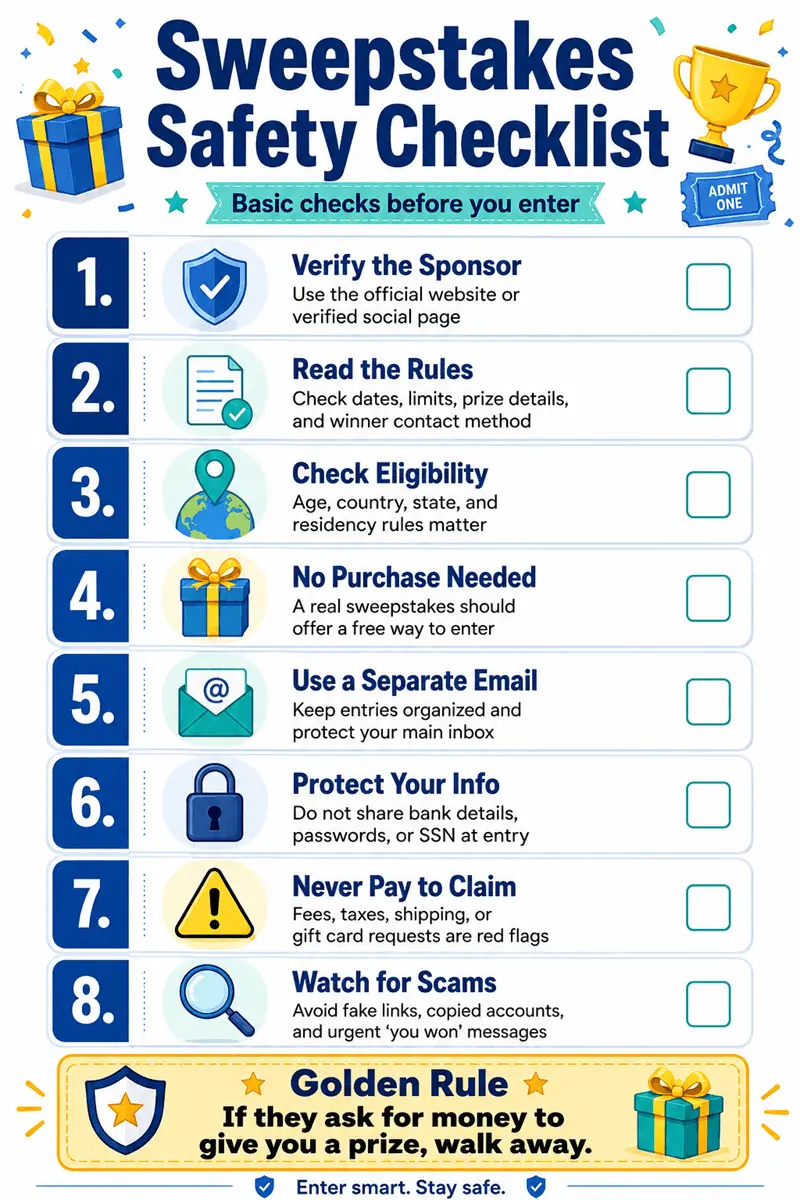
Do not enter every giveaway you see online. Start with sources that are easier to verify:
- Official brand websites
- Verified social media pages
- Publisher websites
- Retailer promotions
- Sweepstakes directories with clear listing standards
- Company newsletters from brands you recognize
- Official app or loyalty-program promotions
The safest place to enter is usually the sponsor’s official page. If a giveaway claims to be from a known brand, go directly to that brand’s verified website or verified social profile instead of clicking random links from comments, DMs, or suspicious emails.
Scammers often hijack real promotions by pretending to be the brand. The FTC warns that scammers may copy or hijack legitimate social media giveaways to steal personal or financial information.
Step 2: Create a Separate Sweepstakes Email
Do not use your main personal email for every sweepstakes.
Create a separate email address only for sweepstakes and online contests. This helps you keep entries organized and protects your main inbox from promotional messages.
A separate email also makes it easier to search for winner notifications. Many prizes are lost because winners miss emails, fail to respond on time, or let messages go to spam.
Use a simple email name that looks normal and professional. Avoid joke names because some sponsors may require identity verification later.
Example: [email protected]
After creating it, check it daily if you are entering actively.
Step 3: Read the Official Rules Before Entering
This is where beginners become serious entrants. The official rules are the real guide to the promotion. They tell you whether you are eligible, how many times you can enter, what the prize includes, and what you must do if you win.
Before entering, check these details:
Eligibility
Look for age, location, and residency requirements. Many U.S. sweepstakes are open only to legal residents of certain states or to people who are at least 18 years old. Some are void in specific states. Some are limited to the U.S. only.
Entry period
Check the start date, end date, and time zone. A sweepstakes may end at 11:59 p.m. Eastern Time, Pacific Time, or another time zone. If you enter after the deadline, your entry may not count.
Entry limit
Look for phrases such as:
- One entry per person
- One entry per email address
- One entry per day
- One entry per household
- Unlimited entries
- Bonus entries allowed
Never ignore entry limits. Duplicate or automated entries can get you disqualified.
Prize details
Check the prize value, number of winners, and whether cash substitution is allowed. A “trip prize” may sound exciting, but the rules may exclude airfare, meals, taxes, transport, or spending money. A “$1,000 value” prize may be a product bundle, not cash.
Winner notification
Look for how the sponsor will contact winners.
Some notify by email. Some use phone. Some use direct message. Some require a response within 24, 48, or 72 hours.
Step 4: Understand “No Purchase Necessary”
This phrase is not decoration. It is one of the most important parts of legitimate sweepstakes.
A real sweepstakes should usually provide a free method of entry. The U.S. Postal Inspection Service states that you never have to purchase an item or pay a fee to enter and win a sweepstakes, and that you should have an equal chance of winning whether or not you order.
In practical terms, this means a brand may sell a product while also running a sweepstakes, but buying the product should not be required to enter or improve your chance of winning.
Sometimes the free entry method is called:
- AMOE
- Alternative Method of Entry
- Free entry method
- Mail-in entry
- Online free entry
For beginners, this is a major safety filter. If a giveaway says you must buy, pay, subscribe, deposit, or send money to enter or improve your odds, read the rules carefully and be cautious.
Step 5: Enter Carefully, Not Randomly
Winning sweepstakes is not about rushing. It is about entering correctly. When you fill out an entry form, use accurate information. Sponsors may verify your identity before awarding a prize. If your name, address, phone number, or email does not match, you may face problems later. Common entry mistakes include:
- Misspelled email address
- Wrong birthdate
- Fake phone number
- Skipping required fields
- Entering from an ineligible state
- Submitting more entries than allowed
- Using multiple emails when rules prohibit it
- Ignoring CAPTCHA or confirmation steps
A clean entry is better than ten careless entries.
Step 6: Build a Simple Tracking System
If you enter only one or two giveaways, you can remember them. But once you start entering regularly, you need a tracking system. You do not need complicated software. A basic spreadsheet is enough.
Track these columns:
| Column | Why It Helps |
|---|---|
| Sweepstakes Name | Helps you identify the promotion |
| Sponsor | Shows who is running it |
| Entry Link | Easy to revisit |
| End Date | Prevents entering expired promotions |
| Entry Frequency | Daily, weekly, one-time, etc. |
| Prize | Helps you prioritize valuable entries |
| Notification Method | Email, phone, DM, mail |
| Notes | Eligibility, restrictions, special rules |
This system prevents wasted effort. It also helps you avoid entering the same sweepstakes too many times if the rules limit entries.
Step 7: Prioritize the Right Sweepstakes
Beginners often chase only big prizes. That is understandable, but it is not always the smartest approach. Large national sweepstakes may have thousands or millions of entries. Smaller promotions may have fewer entrants and better odds, even if the prize is smaller.
A balanced strategy may include:
- Local giveaways
- Niche brand promotions
- Daily entry sweepstakes
- Low-entry social giveaways
- Product giveaways from smaller companies
- Newsletter-based promotions
- Instant-win games
- Seasonal campaigns
Do not focus only on cars, cash, vacations, and million-dollar prizes. Smaller prizes are often more realistic for beginners.
Step 8: Use Bonus Entries Carefully
Many online contests and free entry giveaways offer bonus entries for actions such as:
- Following a social media account
- Sharing a post
- Referring friends
- Joining a newsletter
- Watching a video
- Answering a question
- Visiting a website
Bonus entries can help, but only if they are allowed under the rules and do not compromise your privacy.
Be careful with promotions that ask for too much personal access, such as connecting unknown apps to your social accounts, giving unnecessary permissions, or sharing sensitive information.
Before completing bonus actions, ask: “Is this action reasonable for the prize being offered?”
If the prize is a $25 gift card but the giveaway asks for your full address, birthdate, phone number, and social account access upfront, that is too much.
Step 9: Watch for Winner Notifications
Entering is only half the process. Claiming is the other half.
If you win, the sponsor may require quick action. You may need to reply to an email, sign an affidavit, confirm your mailing address, submit tax information, or provide identity verification.
Check your sweepstakes email regularly. Also check:
- Spam folder
- Promotions tab
- Social media message requests
- Voicemail
- Missed calls
- Mailbox
Do not ignore unfamiliar emails automatically. But do not trust them blindly either.
Verify the sponsor, the promotion name, the official rules, and the sender’s domain before sending any information.
Step 10: Know the Scam Red Flags
This step is non-negotiable. A real sweepstakes should not ask you to pay to claim a prize. Scammers commonly ask for money through gift cards, wire transfers, cryptocurrency, payment apps, or fake “processing” fees.
Watch for these red flags:
- “You won” but you never entered
- You must pay before receiving the prize
- You are asked to keep the prize secret
- The message uses pressure or urgency
- The sender uses a Gmail/Yahoo account instead of a company domain
- The prize is extremely large but details are vague
- You must send bank details immediately
- You are asked for a gift card code
- The account looks like a copy of a real brand page
- The message has poor grammar or suspicious links
The FTC says scammers may send texts, emails, or social media messages claiming you won a gift card, discount code, iPad, car, or other prize, and warns consumers not to respond or click suspicious links.
A useful rule: if you must pay to receive a prize, treat it as a scam until proven otherwise.
Step 11: Understand Taxes Before You Win
Prizes can have tax consequences.
Many beginners think free prizes are completely free. They may not be.
The IRS says prizes and awards may be taxable, and its Interactive Tax Assistant helps determine whether a prize or award must be included in income.
If you win a prize with significant value, the sponsor may ask you to complete tax paperwork. In the U.S., prizes valued at $600 or more often trigger reporting paperwork, though exact handling can depend on the prize, sponsor, and circumstances.
Before chasing high-value prizes, think about the real cost.
A vacation prize may include taxable value. A car prize may create tax, title, registration, and insurance costs. A product prize may require storage, shipping coordination, or maintenance.
Winning is exciting, but a smart entrant understands the full responsibility.
Step 12: Protect Your Personal Information
A legitimate sweepstakes may ask for your name and email at entry. It may ask for more information if you win.
But you should be careful about giving sensitive information too early.
At the entry stage, be cautious if a giveaway asks for:
- Social Security number
- Bank account details
- Credit card number
- Passwords
- Photo ID upload
- Full date of birth without clear reason
- Payment app login
- Crypto wallet access
Some information may be required after winning for tax or verification purposes, especially for larger prizes. But the timing matters. A basic entry form should not look like a financial application.
Read the privacy policy when entering bigger promotions. Understand whether your data may be shared with marketing partners.
Step 13: Learn From Real Cases
Even well-known sweepstakes brands can face scrutiny if consumers are misled.
In 2025, the FTC announced it was sending more than $18 million in refunds to consumers harmed by Publishers Clearing House practices. The FTC said its action led to PCH agreeing to pay $18.5 million in refunds and make substantial changes to its ecommerce operations.
This does not mean every sweepstakes is bad. It means beginners should not rely only on brand familiarity. Always read the rules, check whether purchases affect entry, and watch for confusing sales pressure.
A legitimate sweepstakes should make the entry process clear, not make you feel that buying something is necessary to improve your chances.
Step 14: Create a Weekly Sweepstakes Routine
You do not need to enter contests all day.
A realistic beginner routine may look like this:
Daily — 10 to 20 minutes
- Check winner notifications
- Enter daily sweepstakes
- Claim free entries
- Update your tracker
Weekly — 30 to 60 minutes
- Find new sweepstakes
- Remove expired ones
- Review high-value prizes
- Check social media giveaways
- Clean spam and suspicious emails
Monthly — 30 minutes
- Review what worked
- Remove low-quality sources
- Update your strategy
- Check privacy settings
- Unsubscribe from spammy lists
The goal is consistency, not obsession.
Step 15: Enter With the Right Mindset
Sweepstakes should be treated as entertainment, not income.
You may win. You may not. Even experienced entrants can go long periods without winning anything meaningful.
The healthiest approach is:
- Enter free or low-risk promotions
- Avoid paying to chase prizes
- Track your time
- Protect your data
- Stay realistic
- Enjoy the process
If entering sweepstakes starts feeling stressful, compulsive, or financially pressured, step back.
Beginner Checklist Before Entering Any Sweepstakes
Use this quick checklist:
- Is the sponsor clearly named?
- Is there an official rules page?
- Is the promotion currently active?
- Am I eligible by age and location?
- Is the entry method clear?
- Is no purchase necessary?
- Are entry limits explained?
- Is the prize clearly described?
- Does the notification method make sense?
- Is the website or social account legitimate?
- Are they asking for unnecessary personal information?
- Are they asking for money upfront?
If several answers feel unclear, skip it. There will always be another sweepstakes.
Common Beginner Mistakes
Entering without reading rules
This leads to disqualification, missed deadlines, or entering promotions you were never eligible for.
Using the same password everywhere
Never create accounts with the same password you use for banking, email, or important services.
Trusting every “winner” message
Scammers often contact people claiming they won something. Always verify.
Ignoring tax value
A high-value prize may come with tax responsibility.
Entering low-quality giveaways
Some giveaways exist mainly to collect emails or followers. Choose quality over quantity.
Forgetting to check email
Many prizes are forfeited because winners do not respond in time.
How to Find Better Sweepstakes as a Beginner
Look for sweepstakes where the rules are clear and the sponsor is easy to verify.
Good places to look include:
- Brand websites
- Retailer promotion pages
- Verified Instagram or Facebook pages
- Email newsletters from trusted brands
- Local business promotions
- Radio station websites
- Magazine and publisher giveaways
- Product launch campaigns
- Event-based giveaways
- Sweepstakes directories with updated listings
When using social media, search carefully. Fake accounts often copy profile photos, names, and posts from real brands. Check the username, verification status, follower history, website link, and comments before entering.
What Makes a Sweepstakes Worth Entering?
A good sweepstakes usually has five qualities.
First, the sponsor is real and easy to verify.
Second, the rules are clear.
Third, the prize is clearly described.
Fourth, the entry process does not ask for excessive information.
Fifth, the odds feel reasonable for the time required.
A $5,000 prize with a clean one-minute entry may be worth trying. A $50 prize that requires ten social actions, referrals, app downloads, and personal data may not be worth your time. Your time also has value.
Final Thoughts
Getting started with sweepstakes is easy. Doing it wisely takes a little structure.For beginners, the best strategy is not to enter every giveaway online. The best strategy is to enter legitimate sweepstakes consistently, read the rules, protect your information, track your entries, and avoid anything that asks for money to claim a prize.
Sweepstakes can be fun. They can also be misleading if you do not know what to look for. Start small. Use a separate email. Read the official rules. Learn the warning signs. Keep your expectations realistic. That is the safest way to approach sweepstakes for beginners and learn how to enter online contests without falling for fake promotions or unsafe free entry giveaways.
FAQ
Are sweepstakes free to enter?
Legitimate sweepstakes should usually offer a free method of entry. The FTC says real sweepstakes are free and winners are selected by chance; paying to increase your odds is a scam warning.
Can I really win online sweepstakes?
Yes, people do win legitimate sweepstakes, but winning is never guaranteed. Your chance depends on the number of entries, prize structure, eligibility rules, and random drawing process.
Is it safe to enter online contests?
It can be safe if you use verified sources, read official rules, protect your personal information, and avoid promotions that ask for payment or sensitive data upfront.
What information should I avoid sharing?
Avoid sharing your Social Security number, banking details, passwords, payment app login, or credit card information at the entry stage. Larger prizes may require tax forms after you are confirmed as a winner, but verify the sponsor first.
Do sweepstakes prizes count as taxable income?
Prizes and awards may be taxable under IRS rules. If you win a significant prize, keep records and consult a qualified tax professional.
What is the best strategy for beginners?
Use a dedicated sweepstakes email, enter only legitimate promotions, track entries in a spreadsheet, prioritize clear rules, avoid payment requests, and check winner notifications daily.
How do I know if a giveaway is fake?
A giveaway may be fake if you never entered, the sponsor is unclear, the account is a copycat, the link looks suspicious, or you are asked to pay money to receive the prize. The FTC warns that scammers often use texts, emails, and social media messages to trick people with fake prize claims.